Modernist Golden Landscape I Abstract Printed in Spain Selina Gallery Art
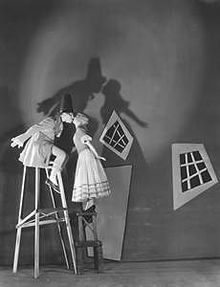
A publicity nonetheless from The Honey of Zero,[i] a 1927 advanced curt flick by Robert Florey
The avant-garde (;[two] In French: [avɑ̃ɡaʁd] [3] 'advance guard' or 'vanguard', literally 'fore-baby-sit')[4] is a person or work that is experimental, radical, or unorthodox with respect to fine art, culture, or society.[4] [5] [six] It is frequently characterized by aesthetic innovation and initial unacceptability.[vii]
The avant-garde pushes the boundaries of what is accustomed as the norm or the status quo, primarily in the cultural realm. The advanced is considered by some to be a hallmark of modernism.[eight] Many artists have aligned themselves with the avant-garde movement, and still continue to exercise so, tracing their history from Dada through the Situationists and to postmodern artists such every bit the Language poets around 1981.[9] [ failed verification ]
The avant-garde also promotes radical social reforms. This meaning was evoked by the Saint Simonian Olinde Rodrigues in his essay, "L'artiste, le savant et fifty'industriel" ("The creative person, the scientist and the industrialist", 1825). This essay contains the first use of "avant-garde" in its now customary sense; there, Rodrigues called on artists to "serve as [the people'due south] avant-garde", insisting that "the power of the arts is indeed the almost immediate and fastest way" to social, political and economical reform.[10]
History [edit]
The term was originally used by the French military to refer to a small-scale reconnaissance group that scouted ahead of the primary force. Information technology as well became associated with left-wing French radicals in the 19th century who were agitating for political reform. At some point in the middle of that century, the term was linked to art through the idea that fine art is an instrument for social change. Only toward the stop of the century did l'fine art d'avant-garde begin to break away from its identification with left-fly social causes to become more aligned with cultural and artistic issues. This trend toward increased accent on aesthetic issues has continued to the present. Advanced today generally refers to groups of intellectuals, writers, and artists, including architects, who vox ideas and experiment with creative approaches that challenge electric current cultural values. Avant-garde ideas, especially if they embrace social bug, often are gradually assimilated by the societies they confront. The radicals of yesterday become mainstream, creating the environment for a new generation of radicals to sally.[11]
Theories [edit]
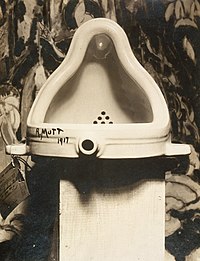
Several writers accept attempted to map the parameters of avant-garde activity. Italian essayist Renato Poggioli provides one of the primeval analyses of vanguardism[ description needed ] as a cultural miracle in his 1962 volume, Teoria dell'arte d'avanguardia (The Theory of the Avant-garde).[12] Surveying the historical, social, psychological and philosophical aspects of vanguardism, Poggioli reaches beyond individual instances of art, poetry, and music to testify that vanguardists may share certain ethics or values, which manifest themselves in the not-conformist lifestyles they prefer. He sees vanguard civilization as a variety or subcategory of Bohemianism.[13] Other authors have attempted both to clarify and to extend Poggioli's written report. The German literary critic Peter Bürger'southward Theory of the Avant-Garde (1974) looks at the Establishment'due south embrace of socially critical works of art, and suggests that in complicity with commercialism, "art as an establishment neutralizes the political content of the individual work."[xiv]
Raymond Williams devotes 2 chapters of his volume, The Politics of Modernism(1989), to a discussion of the politics and language of the avant-garde.
Bürger'due south essay also greatly influenced the work of contemporary American art historians such as the German Benjamin H. D. Buchloh (born 1941). Buchloh, in the drove of essays Neo-avantgarde and Civilisation Industry (2000), critically argues for a dialectical approach to these positions.[fifteen] Subsequent criticism theorized the limitations of these approaches, noting their confining areas of analysis, including Eurocentric, chauvinist, and genre-specific definitions.[16]
Relation to mainstream lodge [edit]
The concept of advanced refers primarily to artists, writers, composers, and thinkers whose work is opposed to mainstream cultural values, and often has a trenchant social or political edge. Many writers, critics, and theorists made assertions nigh vanguard civilisation during the formative years of modernism, although the initial definitive argument on the advanced was the essay "Avant-garde and Kitsch", by New York art critic Clement Greenberg. It was published in Partisan Review in 1939.[17] Greenberg argued that vanguard civilization has historically been opposed to "loftier" or "mainstream" culture, and that information technology has as well rejected the artificially synthesized mass culture that has been produced by industrialization. Each of these media is a directly product of commercialism—they are all now substantial industries—and equally such, they are driven by the same profit-fixated motives of other sectors of manufacturing, non the ideals of truthful fine art. For Greenberg, these forms were therefore kitsch - phony, faked, or mechanical civilization. Such things often pretended to be more than they were by using formal devices stolen from vanguard civilisation. For instance, during the 1930s, the advertising manufacture was quick to take visual mannerisms from surrealism, simply this does not mean that 1930s advertizing photographs are truly surreal.

Similar views were argued by members of the Frankfurt School, the originators of Critical Theory, an approach to social philosophy that focuses on reflective assessment and critique of gild and civilization in lodge to reveal and challenge power structures. Theodor Adorno and Max Horkheimer in their essay "The Culture Industry: Enlightenment as Mass-Deception" (1944), and likewise Walter Benjamin in his highly influential "The Piece of work of Art in the Age of Mechanical Reproduction" (1935, rev. 1939) spoke of "mass culture."[18] They indicated that this bogus culture is constantly being manufactured by a newly emerged culture industry (comprising commercial publishing houses, the movie industry, the record manufacture, and the electronic media).[19] They also pointed out that the rise of this industry meant that artistic excellence was displaced by sales figures equally a measure of worth: a novel, for example, was judged meritorious solely on whether information technology became a best-seller; music succumbed to ratings charts, and to the blunt commercial logic of the Gilded disc. In this way, the autonomous artistic merit, so beloved to the vanguardist, was abandoned and sales increasingly became the measure, and justification, of everything. Consumer culture now ruled.[19]
The avant-garde'due south co-option past the global backer market place, by neoliberal economies, and by what Guy Debord called The Society of the Spectacle (a seminal text for the Situationist motility describing the "autocratic reign of the market economic system"), have made gimmicky critics speculate on the possibility of a meaningful avant-garde today. Paul Mann's Theory-Decease of the Advanced demonstrates how completely the avant-garde is embedded inside institutional structures today, a idea also pursued by Richard Schechner in his analyses of avant-garde operation.[20]
Despite the central arguments of Greenberg, Adorno, and others, various sectors of the mainstream civilization industry have co-opted and misapplied the term "avant-garde" since the 1960s, chiefly as a marketing tool to publicise popular music and commercial movie house. Information technology has go mutual to depict successful stone musicians and historic picture show-makers every bit "avant-garde", the very word having been stripped of its proper meaning. Noting this important conceptual shift, major contemporary theorists such as Matei Calinescu in 5 Faces of Modernity: Modernism, Avant-garde, Decadence, Kitsch, Postmodernism (1987),[ folio needed ] and Hans Bertens in The Idea of the Postmodern: A History (1995),[ folio needed ] accept suggested that this is a sign our civilization has entered a new mail-mod historic period, when the former modernist ways of thinking and behaving accept been rendered redundant.[21]
Notwithstanding, an incisive critique of vanguardism as against the views of mainstream society was offered by the New York critic Harold Rosenberg in the tardily 1960s.[22] Trying to strike a balance between the insights of Renato Poggioli and the claims of Cloudless Greenberg, Rosenberg suggested that, from the mid-1960s onward, progressive civilisation ceased to fulfill its quondam adversarial part. Since then it has been flanked by what he called "avant-garde ghosts to the one side, and a changing mass culture on the other", both of which it interacts with to varying degrees. This has seen culture become, in his words, "a profession 1 of whose aspects is the pretense of overthrowing information technology."[23]
Advanced is frequently defined in contrast to arrière-garde, which in its original military sense refers to a rearguard force that protects the accelerate-guard.[24] The term was less frequently used than "avant-garde" in 20th-century art criticism.[25] The art historians Natalie Adamson and Toby Norris debate that arrière-garde is non reducible to a kitsch style or reactionary orientation, but can instead be used to refer to artists who engage with the legacy of the avant-garde while maintaining an awareness that doing then is in some sense anachronistic.[26] The critic Charles Altieri argues that advanced and arrière-garde are interdependent: "where at that place is an avant-garde, there must be an arrière-garde."[27]
Examples [edit]
Music [edit]
Avant-garde in music can refer to whatsoever grade of music working inside traditional structures while seeking to breach boundaries in some manner.[28] The term is used loosely to describe the work of any musicians who radically depart from tradition altogether.[29] By this definition, some avant-garde composers of the 20th century include Arnold Schoenberg,[xxx] Richard Strauss (in his earliest work),[31] Charles Ives,[32] Igor Stravinsky,[30] Anton Webern,[33] Edgard Varèse, Alban Berg,[33] George Antheil (in his earliest works only), Henry Cowell (in his earliest works), Harry Partch, John Muzzle, Iannis Xenakis,[30] Morton Feldman, Karlheinz Stockhausen,[34] Pauline Oliveros,[35] Philip Glass, Meredith Monk,[35] Laurie Anderson,[35] and Diamanda Galás.[35]
There is another definition of "Avant-gardism" that distinguishes information technology from "modernism": Peter Bürger, for example, says avant-gardism rejects the "institution of art" and challenges social and artistic values, and and so necessarily involves political, social, and cultural factors.[29] Co-ordinate to the composer and musicologist Larry Sitsky, modernist composers from the early on 20th century who do not qualify as avant-gardists include Arnold Schoenberg, Anton Webern, and Igor Stravinsky; after modernist composers who exercise not autumn into the category of avant-gardists include Elliott Carter, Milton Babbitt, György Ligeti, Witold Lutosławski, and Luciano Berio, since "their modernism was not conceived for the purpose of goading an audition."[36]
The 1960s saw a wave of costless and avant-garde music in jazz genre, embodied past artists such as Ornette Coleman, Lord's day Ra, Albert Ayler, Archie Shepp, John Coltrane and Miles Davis.[37] [38] In the stone music of the 1970s, the "fine art" descriptor was generally understood to mean "aggressively avant-garde" or "pretentiously progressive".[39] Post-punk artists from the late 1970s rejected traditional rock sensibilities in favor of an advanced aesthetic.
Theatre [edit]
Whereas the avant-garde has a significant history in 20th-century music, it is more pronounced in theatre and operation fine art, and frequently in conjunction with music and sound design innovations, also every bit developments in visual media design. There are movements in theatre history that are characterized by their contributions to the avant-garde traditions in both the United States and Europe. Among these are Fluxus, Happenings, and Neo-Dada.
Art movements [edit]
- Abstract expressionism
- Artivism
- COBRA
- Conceptual art
- Constructivism
- Cubism
- Dadaism
- De Stijl
- Expressionism
- Fauvism
- Fluxus
- Futurism
- Happening
- Imaginism
- Imagism
- Impressionism
- Incoherents
- Land fine art
- Les Nabis
- Lyrical Abstraction
- Minimal art
- Neo-Dada
- Orphism
- Popular fine art
- Precisionism
- Primitivism
- Rayonism
- Situationism
- Suprematism
- Surrealism
- Symbolism
- Tachisme
- Universal Constructivism
- Viennese Actionism
- Vorticism
- Creationism
- Nadaism
- Stridentism
- Ultraist
Meet also [edit]
- Anti-art
- Bauhaus
- Experimental film
- Experimental literature
- Experimental music
- Experimental theatre
- L'enfant terrible
- List of avant-garde artists
- Outsider art
- Relationship betwixt avant-garde art and American pop culture
- Russian advanced
References [edit]
- ^ The Honey of Zero on YouTube
- ^ "avant-garde adjective - Definition, pictures, pronunciation and usage notes - Oxford Advanced Learner'due south Dictionary at OxfordLearnersDictionaries.com". world wide web.oxfordlearnersdictionaries.com.
- ^ John C. Wells, Longman Pronunciation Dictionary, tertiary edition (Harlow: Longman, 2008) ISBN 978-1-4058-8118-0.
- ^ a b "Avant-garde". Dictionary.com. Lexico Publishing Group, LLC. Retrieved xiv March 2007.
- ^ John Picchione, The New Avant-garde in Italy: Theoretical Fence and Poetic Practices (Toronto: University of Toronto Press, 2004), p. 64 ISBN 978-0-8020-8994-6.
- ^ Peter Bürger, Theory of the Avant-Garde, English translation by Michael Shaw, Foreword by Jochen Schulte-Sasse, Theory and History of Literature, Volume 4 (Manchester University Printing, University of Minnesota Press, 1984),[ page needed ]
- ^ Kostelanetz, Richard, A Lexicon of the Avant-Gardes, Routledge, May 13, 2013, ISBN 1-136-80620-2
- ^ Come across for case Raymond Williams'due south essay, "The Politics of the Advanced", collected in his book The Politics of Modernism (Verso 1989)
- ^ UBU Web List of artists from Dada to the nowadays day aligning themselves with the avant-garde
- ^ Matei Calinescu, The Five Faces of Modernity: Modernism, Avant-Garde, Decadence, Kitsch, Postmodernism (Durham: Duke University Press, 1987).[ page needed ]
- ^ Porter, Tom (2004). Archispeak : an illustrated guide to architectural terms. London: Taylor & Francis. ISBN0-415-30011-8. OCLC 53144738.
- ^ Sascha Bru and Gunther Martens, The Invention of Politics in the European Avant-Garde (1906–1940) (Amsterdam: Rodopi, 2006), p. 21. ISBN 90-420-1909-3.
- ^ Renato Poggioli (1968). The Theory of the Avant-garde. Belknap Printing of Harvard University Press. p. 11. ISBN0-674-88216-4. , translated from the Italian by Gerald Fitzgerald
- ^ Peter Bürger (1974). Theorie der Avantgarde. Suhrkamp Verlag. English language translation (Academy of Minnesota Printing) 1984: ninety.
- ^ Benjamin Buchloh, Neo-avantgarde and Culture Industry: Essays on European and American Fine art from 1955 to 1975 (Cambridge: MIT Press, 2001) ISBN 0-262-02454-iii.
- ^ James Yard. Harding: Cut Performances: Collage Events, Feminist Artists, and the American Advanced (Ann Arbor: University of Michigan Press, 2010).[ page needed ]
- ^ Greenberg, Clement (Fall 1939). "Avant-Garde and Kitsch". The Partisan Review. Vol. vi, no. five. pp. 34–49. Retrieved 24 January 2018.
- ^ Walter Benjamin, "The Piece of work of Art in the Age of Mechanical Reproduction" Archived 5 December 2006 at the Wayback Machine[ full citation needed ]
- ^ a b Theodor Due west. Adorno (1963) Archived 29 September 2018 at the Wayback Machine, "Civilization Industry Reconsidered: Selected Essays on Mass Culture", London: Routledge, 1991
- ^ Richard Schechner, "The Conservative Avant-Garde." New Literary History 41.4 (Autumn 2010): 895–913.
- ^ Calinescu 1987,[ page needed ]; Bertens 1995.[ page needed ]
- ^ Harold Rosenberg, The De-Definition of Art: Action Art to Popular to Excavation (Chicago: University of Chicago Press, 1983), p. 219 ISBN 0-226-72673-8. Originally published: New York: Horizon Press, 1972; reprinted New York: Collier Books, 1973.
- ^ George Dickie, ""Symposium on Marxist Aesthetic Thought: Commentary on the Papers by Rudich, San Juan, and Morawski", Arts in Society: Fine art and Social Feel: Our Irresolute Outlook on Culture 12, no. 2 (Summer–Fall 1975): p. 232.
- ^ Adamson, Natalie; Norris, Toby (2009). "Introduction". In Adamson, Natalie; Norris, Toby (eds.). Academics, Pompiers, Official Artists and the Arrière-Garde: Defining Modern and Transitional in French republic. Cambridge Scholars Publishing. p. xviii.
- ^ Adamson & Norris 2009, pp. 17–18.
- ^ Adamson & Norris 2009, pp. 18–19, 20.
- ^ Altieri, Charles (1999). "Avant-Garde or Arrière-Garde in Recent American Poesy". Poetics Today. xx (iv): 633. JSTOR 1773194.
- ^ David Nicholls (ed.), The Cambridge History of American Music (Cambridge and New York: Cambridge Academy Press, 1998), 122–24. ISBN 0-521-45429-viii ISBN 978-0-521-54554-nine
- ^ a b Jim Samson, "Avant garde", The New Grove Dictionary of Music and Musicians, second edition, edited past Stanley Sadie and John Tyrrell (London: Macmillan Publishers, 2001).
- ^ a b c Larry Sitsky, Music of the Twentieth-Century Avant-Garde: A Biocritical Sourcebook (Westport, Conn: Greenwood Press, 2002), fourteen. ISBN 0-313-29689-8.
- ^ Larry Sitsky, Music of the Twentieth-Century Avant-Garde: A Biocritical Sourcebook (Westport, Conn: Greenwood Press, 2002), 13–14. ISBN 0-313-29689-8.
- ^ Larry Sitsky, Music of the Twentieth-Century Avant-Garde: A Biocritical Sourcebook (Westport, Conn: Greenwood Press, 2002), 222. ISBN 0-313-29689-8.
- ^ a b Larry Sitsky, Music of the Twentieth-Century Avant-Garde: A Biocritical Sourcebook (Westport, Conn: Greenwood Press, 2002), 50. ISBN 0-313-29689-viii.
- ^ Elliot Schwartz, Barney Childs, and James Fob (eds.), Contemporary Composers on Contemporary Music (New York: Da Capo Press, 1998), 379. ISBN 0-306-80819-6
- ^ a b c d Larry Sitsky, Music of the Twentieth-Century Avant-garde: A Biocritical Sourcebook (Westport, Conn: Greenwood Press, 2002), xvii. ISBN 0-313-29689-8.
- ^ Larry Sitsky, Music of the Twentieth-Century Avant-garde: A Biocritical Sourcebook (Westport, Conn: Greenwood Press, 2002), xv. ISBN 0-313-29689-8.
- ^ Anon. Avant-Garde Jazz. AllMusic.com, north.d.
- ^ Michael West. "In the year jazz went advanced, Ramsey Lewis went pop with a bang". The Washington Post . Retrieved 30 May 2020.
- ^ Murray, Noel. "60 minutes of music that sum up art-punk pioneers Wire". The A.V. Club . Retrieved thirty May 2020.
Further reading [edit]
- Robert Archambeau. "The Avant-garde in Babel. Two or Three Notes on Four or Five Words", Activeness-Yep vol. 1, issue 8, Autumn 2008.
- Bäckström, Per (ed.), Heart-Periphery. The Avant-Garde and the Other, Nordlit. University of Tromsø, no. 21, 2007.
- Bäckström, Per. [http://actionyes.org/issue7/backstrom/backstrom1.html "One Earth, Four or Five Words. The Peripheral Concept of 'Advanced'", Activeness-Yeah vol. 1, issue 12, Winter 2010.
- Bäckström, Per & Bodil Børset (eds.), Norsk avantgarde (Norwegian Avant-Garde), Oslo: Novus, 2011.
- Bäckström, Per & Benedikt Hjartarson (eds.), Decentring the Avant-Garde, Amsterdam & New York: Rodopi, Avantgarde Critical Studies, 2014.
- Bäckström, Per and Benedikt Hjartarson. "Rethinking the Topography of the International Avant-garde", in Decentring the Avant-Garde, Per Bäckström & Benedikt Hjartarson (eds.), Amsterdam & New York: Rodopi, Avantgarde Critical Studies, 2014.
- Barron, Stephanie, and Maurice Tuchman. 1980. The Avant-garde in Russian federation, 1910–1930: New Perspectives: Los Angeles County Museum of Art [and] Hirshhorn Museum and Sculpture Garden, Smithsonian Establishment, Washington, D. C. Los Angeles: Los Angeles County Museum of Fine art ISBN 0-87587-095-3 (pbk.); Cambridge, MA: Distributed by the MIT Press ISBN 0-262-20040-6 (pbk.)
- Bazin, Germain. 1969. The Avant-garde in Painting. New York: Simon and Schuster. ISBN 0-671-20422-X
- Berg, Hubert van den, and Walter Fähnders (eds.). 2009. Metzler Lexikon Avantgarde. Stuttgart: Metzler. ISBN 3-476-01866-0 (in German)
- Crane, Diana. 1987. The Transformation of the Avant-garde: The New York Art World, 1940–1985. Chicago: Academy of Chicago Press. ISBN 0-226-11789-8
- Daly, Selina, and Monica Insinga (eds.). 2013. The European Avant-garde: Text and Paradigm. Newcastle upon Tyne: Cambridge Scholars. ISBN 978-i-4438-4054-five.
- Fernández-Medina, Nicolás, and Maria Truglio (eds.). Modernism and the Advanced Body in Espana and Italy. Routledge, 2016.
- Harding, James G., and John Rouse, eds. Not the Other Avant-Garde: The Transnational Foundations of Advanced Performance. University of Michigan, 2006.
- Hjartarson, Benedikt. 2013. Visionen des Neuen. Eine diskurshistorische Analyse des frühen avantgardistischen Manifests. Heidelberg: Winter.
- Kostelanetz, Richard, and H. R. Brittain. 2000. A Dictionary of the Avant-Gardes, second edition. New York: Schirmer Books. ISBN 0-02-865379-3. Paperback edition 2001, New York: Routledge. ISBN 0-415-93764-7 (pbk.)
- Kramer, Hilton. 1973. The Age of the Avant-garde; An Art Relate of 1956−1972. New York: Farrar, Straus and Giroux. ISBN 0-374-10238-4
- Léger, Marc James (ed.). 2014. The Idea of the Avant Garde—And What It Ways Today. Manchester and New York: Manchester University Printing; Oakland: Left Curve. ISBN 978-0-7190-9691-4.
- Maerhofer, John Westward. 2009. Rethinking the Vanguard: Aesthetic and Political Positions in the Modernist Debate, 1917–1962. Newcastle upon Tyne: Cambridge Scholars Press. ISBN 1-4438-1135-1
- Isle of mann, Paul. The Theory-Death of the Avant-Garde. Indiana Academy Press, 1991. ISBN 978-0-253-33672-9
- Novero, Cecilia. 2010. Antidiets of the Avant-Garde: From Futurist Cooking to Eat Art. (University of Minnesota Printing) ISBN 978-0-8166-4601-two
- Pronko, Leonard Cabell. 1962. Avant-garde: The Experimental Theater in France. Berkeley: University of California Press.
- Roberts, John. 2015. Revolutionary Fourth dimension and the Avant-Garde. London and New York: Verso. ISBN 978-ane-78168-912-7 (textile); ISBN 978-1-78168-913-4 (pbk).
- Schechner, Richard. "The V Avant-Gardes or ... [and] ... or None?" The Twentieth-Century Performance Reader, 2nd ed., ed. Michael Huxley and Noel Witts (New York and London: Routledge, 2002).
- Schmidt-Burkhardt, Astrit. 2005. Stammbäume der Kunst: Zur Genealogie der Avantgarde. Berlin Akademie Verlag. ISBN 3-05-004066-1 [online version is bachelor]
- Sell, Mike. The Avant-Garde: Race, Religion, State of war. Seagull Books, 2011.
- Shishanov, V. A. 2007. Vitebskii muzei sovremennogo iskusstva: istoriia sozdaniia i kollektsii (1918–1941). Minsk: Medisont. ISBN 978-985-6530-68-8 Online edition (in Russian)
External links [edit]
- Historic Avant-Garde Periodicals for Digital Research, The Blue Mountain Project, Princeton University Library
- Avant-garde and Modernist Magazines (Monoskop)
- Magazines in Bibliothèque Kandinsky, Centre Pompidou, Paris
- Periodicals in Iowa Digital Library, University of Iowa Libraries
- Digital Dada Library of International Dada Archive, University of Iowa Libraries
- Magazines in Digital Collections of Beinecke Rare Book & Manuscript Library
- Avant-garde Periodicals See Digital Archives, New York Public Library
- Dada, Surrealism, and De Stijl Magazines on UbuWeb Historical
- Index of Modernist Magazines, Davidson College Archived 30 August 2016 at the Wayback Automobile
- Modernist Periodical Project, Brown University and Academy of Tulsa
- Spanish and Italian Modernist Studies Forum, Pennsylvania Country University
- Drove: "Spanish Avant-Garde" from the University of Michigan Museum of Fine art
Source: https://en.wikipedia.org/wiki/Avant-garde
0 Response to "Modernist Golden Landscape I Abstract Printed in Spain Selina Gallery Art"
Post a Comment